A Cape Jazz Journey
From the Moravian hymns of Mamre to the concert halls of Stellenbosch — the story of a pianist who found his voice in the rhythm of the Cape.
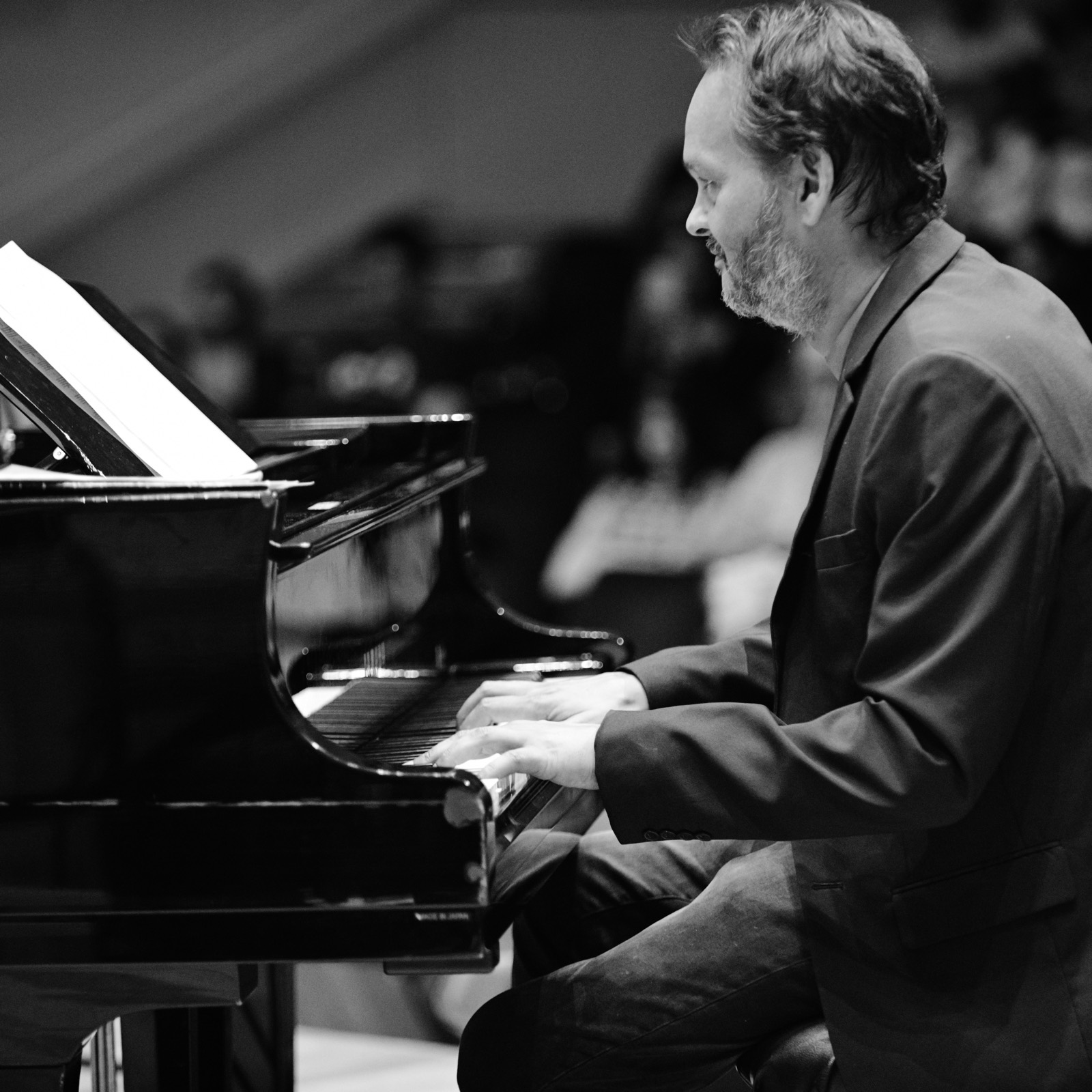
The boy from Mamre
Ramon Hector Alexander was born in Mamre, a small Moravian mission village tucked into the rural hinterland north of Cape Town. Established in the early 1800s on land once roamed by the Khoi captain Klapmuts and his people, Mamre is a place where the past lingers — in the whitewashed mission buildings, the brass of the church band, and the quiet rhythms of community life.
It was here that the future pianist first heard music. Long before he discovered jazz, the soundscape of his childhood was shaped by the brassy sound of Moravian hymns and the surviving legacy of Khoisan music around the historic mission station. These were not influences he went looking for — they were the air he breathed.
His parents were teachers — his mother taught English, his father Geography — and the household valued learning. Music, at first, came not from formal instruction but from the pull of imitation. At five, Ramon began copying his elder brother's piano lessons, picking out by ear what his sibling was struggling to read. That same brother played trumpet in the church band, planting another seed. When his parents divorced, Ramon moved with his eldest sister and her husband to Mossel Bay on the Southern Cape coast, and it was there, at the age of ten, that he received his first proper piano lessons — strictly classical. That discipline would form the bedrock of his technique for the next decade.
A Cuban spark in Grahamstown
Ramon worked his way diligently through classical repertoire at All Saints Primary in Mossel Bay and York High in George. Then, at fifteen, something cracked open. He travelled to the National Arts Festival in Grahamstown — South Africa's great annual gathering of music, theatre and ideas — and encountered a Cuban band called Como No. The syncopation, the conversational interplay, the sheer joy of improvisation: he had never heard anything like it.
He went home and started rifling through his older brother's record collection, where a whole new world was waiting — not the bebop classics he would later study, but the smoother fusion of the 1980s and early 90s: Shakatak, Fourplay, Dave Grusin, Joe Sample and The Crusaders, Bob James, the Brazilian songwriter Djavan, the guitarist Lee Ritenour. An unconventional gateway, but it lit the fuse. From then on, his classical lessons had a rival — and the rival was winning.
The Jazz Workshop
In 1998, freshly out of school and unsure what to study next, an eighteen-year-old Ramon took a gap year and made his way to Cape Town, where he sought out Merton Barrow — the city's foremost jazz educator — at his Jazz Workshop. It was a decision that changed everything.
Under Barrow's guidance, Ramon met the deeper canon that would become his real schooling: Thelonious Monk's angular wit, Bill Evans's introspective lyricism, Keith Jarrett's improvisational courage, the cool architecture of Miles Davis, the harmonic boldness of Herbie Hancock, the rhythmic fire of Chick Corea. For a young man whose ears had been trained on Bach and Chopin, it was a revelation — music that demanded technique but rewarded personality. The Workshop was more than a school; it was a doorway into the Cape Town jazz scene, and Ramon stepped through it and never really came back.
The reluctant winemaker
Then came one of the strangest turns in the story. Ramon won a coveted South African Airways bursary — one of only a handful awarded that year — to study viticulture and oenology at Stellenbosch University. He was, on paper, going to become a winemaker. In practice, it was a quiet four-year identity crisis.
"I was not a very good student during my winemaking course, and I quickly realised I would never be a winemaker or viticulturist. I felt so far removed from my fellow students — they already exuded a love and passion for their future career."
While his classmates dreamed of cellars and cultivars, Ramon dreamed of chord changes. He finished the degree in 2004 — credit where it's due — but his real education happened in rehearsal rooms, church halls and student gigs. Most consequentially, he co-founded a band with a handful of friends called ESP, named after the Miles Davis album. ESP is where Ramon Alexander the composer was born: the group took every gig it could find, and by the time it cut its first album, seven of its twelve tracks carried his name as composer.
Years later, asked about the connection between wine and music, he offered a characteristically elegant answer — his oenology training had taught him about balance: the cerebral and the heartfelt, the structured and the spontaneous. It was a lesson the music never forgot.
From wine shop to lecture hall
After graduating, Ramon dutifully took a job in the wine shop of a hotel. It lasted only briefly. A friend and former ESP bandmate asked whether he'd come and teach music to underprivileged children in Stellenbosch and the surrounding communities. He said yes — and that small, almost accidental act of community service set the course of the rest of his career.
Felicia Lesch of the Stellenbosch University Music Department noticed the young pianist working with the children and recognised something special. She recruited him to teach introductory jazz theory and jazz piano in the conservatory's Music Certificate Programme. What was meant as a part-time gig stretched into eight years. Ramon had stumbled into his vocation: he was a teacher. And in the rooms around the conservatory, between classes and rehearsals, he was quietly becoming a recording artist.
Picnic at Kontiki
In 2010 Ramon released Taxi 1022 with the ESP Band — a document of the group that had carried him through his Stellenbosch years. A year later came the album that announced him as a solo voice: Picnic at Kontiki (2011). Full of original compositions, it caught the ear of South Africa's jazz tastemakers, and the respected broadcaster Eric Alan placed it on his Top 40 jazz releases for the year.
The momentum built quickly. He took the piano chair in the Cape Jazz Band — the genre's most storied repertory ensemble — sitting alongside drummer Jack Momple, guitarist Errol Dyers, the Paul Simon collaborator Tony Cedras, bassist Spencer Mbadu, multi-instrumentalist Mark Fransman and the rising Kyle Shepherd. To sit at that piano was to inherit a lineage.
That chair produced a record: Musical Democracy (2013), released as Cape Jazz Series Vol. 4, with Ramon at the piano on "Three Khois in a Fountain".
Echoes from Louwskloof
In 2015 Ramon released his second solo album, and it was the most personal record he had made. He called it Echoes from Louwskloof — after the place near Mamre where the Khoi captain Klapmuts and his people had lived before the missionaries came. The album was a homage in two directions at once: back to his musical forefathers, the Cape Jazz pianists whose tradition he was inheriting, and further back still, to the first people of his birthplace. Tracks like Louwskloof se Mense ("The People of Louwskloof") wove that history into the harmonic language of contemporary jazz.
"Louwskloof se Mense were some of the first inhabitants of Moravian Mamre. The album is an homage to my musical forefathers — and to the forefathers of my birthplace."
The record was made with Leonardo Fortuin — who has managed Ramon since 2015 — as its executive producer, and it earned Ramon something he had worked toward for almost two decades: his first appearance at the Cape Town International Jazz Festival, in 2016. His working group in these years — bassist Chadleigh Gowar, drummer Annemie Nel, saxophonist Zeke Le Grange and vocalist Sima Mashazi — became a tight, expressive unit that toured the album widely.
Receiving the baton
In 2018 Mountain Records released a compilation called Cape Jazz Piano, and Ramon's name appeared among the living elders of the tradition — a symbolic passing of the baton from figures like Robbie Jansen, Mac McKenzie, Merton Barrow, Winston Mankunku, Basil Coetzee and the great Ibrahim Khalil Shihab to the next generation.
Around the same time Ramon stepped fully into the producer's chair on a major project: Essence of Spring, an album for Ibrahim Khalil Shihab himself — one of the towering figures of South African jazz piano — again with Leonardo Fortuin as executive producer. To be entrusted with a Shihab record was, in its own quiet way, the highest possible compliment. The student had become a custodian. By now Ramon was also one of the few serious scholars of goema — the rhythmic tradition born from the Cape's enslaved and Khoi communities, and the root system of all Cape Jazz. That pulse increasingly ran through his playing, not as ornament but as foundation.
A sought-after voice
As his reputation grew, Ramon became one of the most in-demand pianists in the country — at home in straight-ahead jazz, at Afrikaans cultural festivals, and in crossover collaborations alike. He shared stages with the American flautist Hubert Laws, saxophonists Khaya Mahlangu and McCoy Mrubata, the late Robbie Jansen, guitarist Errol Dyers and the Japanese trumpet legend Terumasa Hino, and accompanied singers and songwriters far beyond jazz purism.
And the world began to call. He performed across Europe and Asia; his ensemble appeared at the Borneo International Jazz Festival, and in 2019 he held a residency at the No Black Tie Jazz Club in Kuala Lumpur — a small, fabled room that has hosted some of the great names in international jazz.
The teacher
For all his success on stage, perhaps Ramon's deepest legacy is being built in classrooms. He returned to Stellenbosch University not as a winemaking student but as a jazz lecturer, and today he leads the jazz division of the university's music department, teaching the very thing that, for him, defines the music.
"You can fake the sound of jazz by performing transcribed music — but if it's devoid of improvisation, then the true spirit of jazz is lost."
Beyond the conservatory he runs jazz-ensemble workshops for youth bands across the Western Cape. In 2024 he sat on the selection panel for the National Youth Jazz Band in Makhanda — the very programme that had selected him as its pianist twenty years earlier, in 2004, when he was a Stellenbosch undergraduate. The circle had closed.
Looking forward
In 2025 Ramon returned to the Toyota Stellenbosch Woordfees with a special concert revisiting the music of his ESP days — a tribute to the Stellenbosch band that had helped shape his voice — while previewing brand-new material from an album due in 2026. His quintet for the project featured saxophonist Danel Dippenaar, guitarist Joshua America, double bassist Dylan Tabisher and his long-time drummer Annemie Nel. In February 2026 he appeared at the university's Fismer Hall in a trio with the German bassist Martin Zenker — a programme described as forward-looking yet rooted in soulful South African jazz.
The pianist who once wasn't sure what to study after matric is now, two decades on, one of the indispensable figures in Cape Jazz — performer, composer, producer, scholar and teacher all at once.
The rhythm of place
Ramon Alexander's story is, in the end, a story about place. About the soil of Mamre and the brass of Moravian hymns. About a Cuban band heard in Grahamstown and a Jazz Workshop found in Cape Town. About vineyards he never quite belonged to and a lecture hall he was never supposed to enter. His music carries all of it at once: the hymnody of the mission station, the goema pulse of the Cape, the sophistication absorbed from Monk and Evans and Jarrett and Hancock, and the balanced refinement of a man who once trained to make wine. He represents a generation of "sons" to whom the "captains" of Cape Jazz have handed the helm — and by every account, the ship is in steady hands.